
An international background check typically takes 5 to 20 business days, depending on the countries involved, check types required, and responsiveness of third-party sources. Some checks, especially in countries with strict privacy laws or manual record systems, can take 4 to 6 weeks.
This guide covers:
- international background check timelines by check type
- country and region-level timeline estimates
- factors that slow down global screening
- steps employers can take to reduce delays
How Long Does an International Background Check Typically Take?
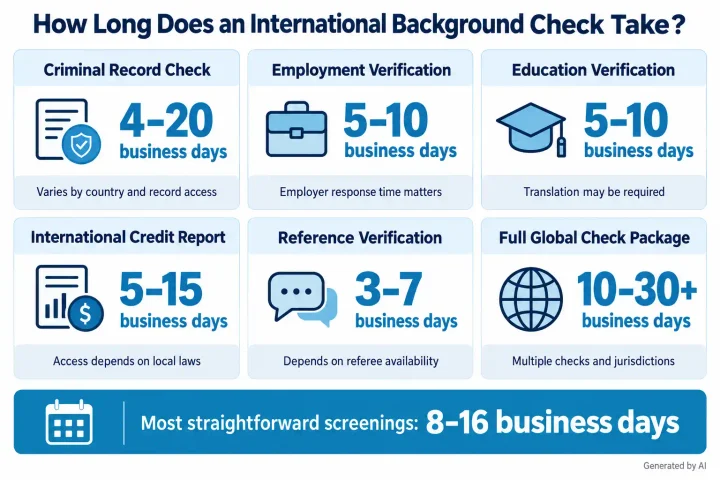
How long does an international background check take? Most international background checks take 5 to 20 business days, but international background check turnaround time depends on the check type, country, record source, and whether manual verification, document translation, or third-party follow-up is required.
Check Type | Typical Timeline | Notes |
International criminal record check | 4–20 business days | Varies by country; privacy-law countries take longest |
International employment verification | 5–10 business days | Faster when former employer responds quickly |
International education verification | 5–10 business days | May require credential translation in some countries |
International credit report | 5–15 business days | Country-specific consumer laws affect access speed |
Reference verification (international) | 3–7 business days | Depends on availability and responsiveness of referees |
Full global background check package | 10–30+ business days | Combines multiple check types across multiple jurisdictions |
Many straightforward international screenings fall within an 8–16 business day range, but complex records, slow jurisdictions, or multi-country histories can extend the international background check time. For help planning a realistic timeline, learn more about AIS international background check services.
The following sections explain what drives these timelines, and what employers can do to speed up the process.
How Long Does an International Background Check Take by Country?
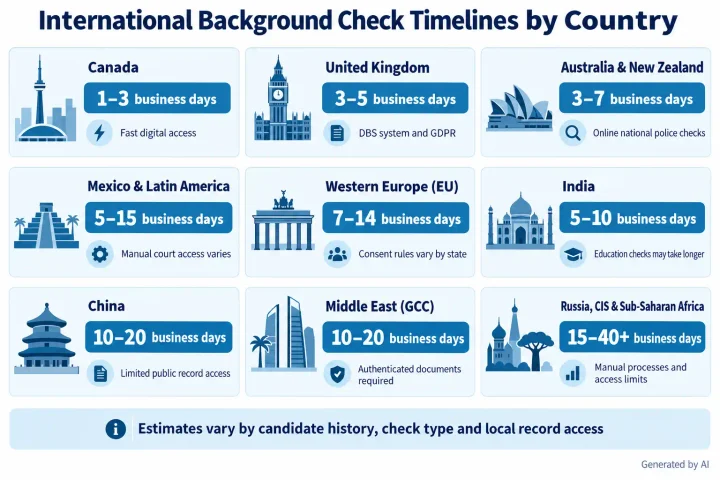
International background check time and international background check turnaround time vary by country because each jurisdiction has different record systems, privacy laws, court access rules, employer response patterns, and document requirements.
The global background check timeline estimates below are approximate and can vary based on candidate history and specific check requirements.
Country / Region | Estimated Timeline | Key Factors |
Canada | 1–3 business days | Fast digital access; PIPEDA-compliant process |
United Kingdom | 3–5 business days | DBS check system; GOV.UK notes that a basic DBS check takes 3 days on average; GDPR requirements apply |
Australia / New Zealand | 3–7 business days | National Police Check available online |
Mexico / Latin America | 5–15 business days | Manual court access common; varies by state |
Western Europe (EU) | 7–14 business days | GDPR consent requirements; varies by member state |
India | 5–10 business days | Education verification can lag; document translation sometimes needed |
China | 10–20 business days | Limited public record access; manual verification required |
Middle East (GCC) | 10–20 business days | Requires authenticated documents; government processing involved |
Russia / Former CIS | 15–30+ business days | Limited cooperation; privacy restrictions common |
Sub-Saharan Africa | 15–40+ business days | Infrastructure gaps; manual processes are standard |
These timelines are directional estimates. How long does a background check take internationally? The answer can change based on the candidate’s residence history, number of countries involved, check package requested, and whether records require translation, authentication, or direct institutional follow-up.
What Factors Affect How Long an International Background Check Takes?
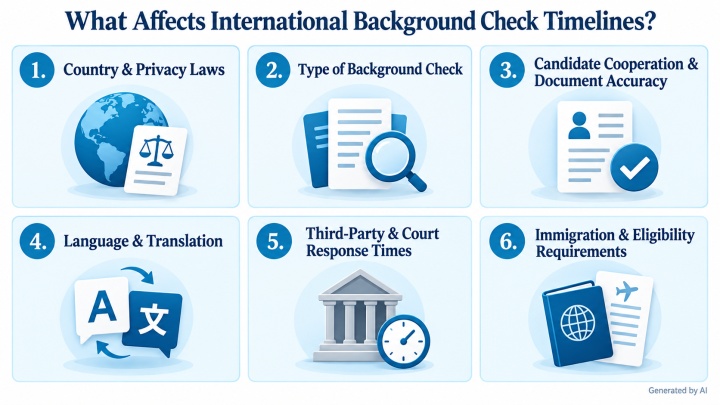
A background check for foreign employees takes longer when records cross borders, require translation, need manual verification, or fall under local privacy and employment laws. How long does a background check take internationally depends on country rules, check type, candidate cooperation, language needs, third-party response times, and immigration requirements.
1. The Country of Origin and Its Privacy Laws
The candidate’s country of origin can significantly affect international employment background check timelines because record access, privacy laws, and government processes vary by country. Some countries offer fast digital access, while others require manual searches, strict consent documentation, or government-issued record requests. If a candidate is entering the U.S. for a domestic role, immigration requirements may also affect timing and eligibility planning.
2. Type of Background Check Required
The type of international background check requested directly affects the timeline because each check uses different record sources. A criminal record check from every country where the candidate lived for more than six months may take longer than a simple reference check. Education verification, credit reports, employment references, and company checks each add separate steps, sources, and possible delays. Broader screening packages usually take longer because each added search introduces another source to verify.
3. Candidate Cooperation and Document Accuracy
Candidate cooperation can speed up or slow down a global background check. Employers should collect complete legal name history, countries of residence, dates of employment, education details, consent forms, and supporting documents as early as possible. Inaccurate names, missing addresses, incomplete school records, or delayed consent forms can create avoidable back-and-forth. Clear instructions at the start help reduce errors before verification begins.
4. Language and Translation Requirements
Language and translation requirements can add time when records, credentials, references, or official documents are not available in English. Education verification can be especially tricky because different countries have different credential systems, transcript formats, and document policies. In some cases, credentials must be translated before they can be properly assessed, and work references may also require translation to avoid confusion.
5. Third-Party and Court Response Times
Third-party response times often determine international screening timelines because employers, schools, courts, government offices, and reference contacts may all need to respond. For example, Australia’s National Police Checking Service notes that police checking is a partially manual, name-based process, and around 30% of checks are referred for manual processing.
Criminal record checks may depend on current residence, prior countries of residence, and local court access. These dependencies are also among the top reasons background checks get delayed. Employers should plan for external response times early in hiring plans.
6. Immigration and Eligibility Requirements
Immigration and eligibility requirements can affect both timing and hiring risk when a foreign candidate is being considered before entering the United States for work. U.S. immigration and customs processes may uncover some eligibility issues, but employers may still need screening before making a final decision. A negative criminal record, unverifiable work history, or eligibility concern can affect whether the candidate can move forward.
Employers should also follow applicable background check compliance requirements when employment decisions depend on the results.
How Can Employers Speed Up an International Background Check?
Employers can improve international background check turnaround time by collecting complete information early, choosing role-appropriate checks, obtaining proper consent, and working with a provider that understands background check requirements for foreign employees.
- Collect complete candidate information upfront. Include all countries of residence, full legal name history, employer details, education records, and current contact information.
- Start as early as legally permissible. International screening depends on third parties, so early initiation gives employers more room to manage the global background check timeline.
- Use a provider with in-country partners. Local partners can reduce cold-start delays and navigate country-specific record systems, privacy rules, and document requirements.
- Obtain signed consent forms early. Consent requirements vary by country, especially in GDPR-regulated regions, where consent must generally be freely given, informed, specific, clearly stated, and possible to withdraw.
- Prepare for credential translation. Identify education records, employment documents, or certificates that may need certified translation.
- Build realistic timelines into offer planning. Avoid start dates that depend on rapid completion in slow jurisdictions.
- Consider phased onboarding where appropriate. For lower-risk roles, phased onboarding may be possible while slower checks continue.
A clear international employment background check process helps hiring teams manage timelines before start dates are affected. Working with AIS international background checking services can help employers reduce avoidable delays.
How AIS Handles International Background Checks
International background checks require country-specific knowledge, accurate candidate information, proper consent, and realistic expectations about local response times. For HR teams, the goal is to keep hiring moving without sacrificing accuracy or compliance.
AIS supports international employment background check needs by coordinating global screening steps, working through in-country partners where appropriate, and helping employers manage checks across countries, record types, and third-party sources. This helps hiring teams set clearer expectations, reduce avoidable delays, and make more confident decisions when screening international candidates.