
Applicant-submitted pay stubs, offer letters, and even self-filed tax returns can be incomplete, altered, or fabricated. When employment or income needs to be verified, relying only on documents controlled by the applicant can leave important gaps.
The IRS Income Verification Express Service, or IVES, is the IRS’s consent-based option for obtaining employment- and income-related tax records directly from the source. For organizations evaluating an employment verification service, IVES provides an IRS-source way to compare reported information with tax records rather than relying only on applicant-submitted documents.
IVES can complement broader screening programs and the benefits of background checks by giving organizations an independent IRS-source record to compare with applicant-provided information.
This guide explains what IVES is, how the process works, what is available for personal and business filings, why IRS-source verification can be stronger than self-submitted documents, where IVES is used, and why AIS is positioned to provide access to the service.
What Is IVES, and Who Can Use It?
IVES stands for Income Verification Express Service. It is an IRS consent-based program that allows authorized IVES Participating Companies to request tax transcripts and wage information after the taxpayer authorizes the release.
If you are researching what employment verification is, the broader process involves confirming employment history, earnings, or both. What is income verification? It is the process of confirming reported income for an appropriate business purpose. For organizations evaluating an employment verification service, IVES provides an IRS-direct option when tax-record information is relevant.
As an income verification service, IVES is specifically focused on tax transcript and wage information. It is not an EIN lookup, criminal history search, or identity-theft transcript service.
The IRS, Income Verification Express Service explains that taxpayers can authorize banks, lenders, and other organizations to access tax records for mortgages, loans, or other services.
Companies must participate in IVES or work through an authorized Participating Company. According to IRS, Income Verification Express Service for participants, enrolled participants can request transcripts online or by fax. The IRS currently charges participants $4 per transcript requested; that is an IRS participant fee, not AIS client pricing.
How IVES Works: From Consent to IRS Transcript
The IRS income verification express service follows a consent-based process. A taxpayer authorizes specified IRS records, an authorized participant submits the request, and the transcript is returned through IVES. Here’s how it works.
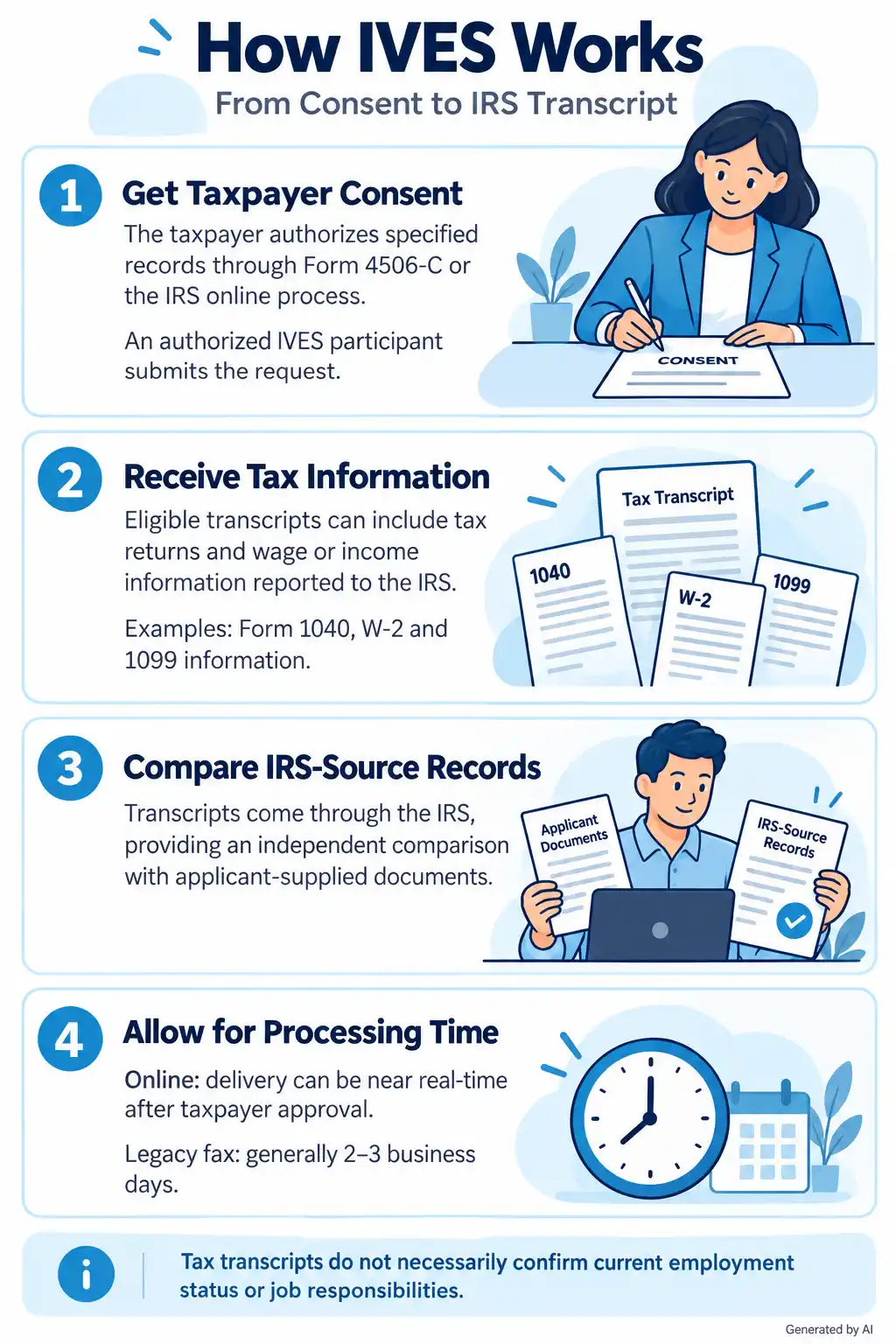
1. Getting Consent
Consent comes first. IVES requests use information captured on Form 4506-C, IVES Request for Transcript of Tax Return. Requests may be submitted through the IRS online process or the legacy fax process.
The IRS, Form 4506-C, IVES Request for Transcript of Tax Return identifies the taxpayer, IVES participant and client company, transcript type, and tax year or period requested. The IRS must receive a signed Form 4506-C within 120 days of the taxpayer’s signature date. Online requests require the taxpayer to review and authorize the request electronically.
2. What Data Comes Back
Wage and income transcripts can include information reported on Forms W-2 and the 1099 series, while tax return transcripts can include Form 1040-series information and eligible business returns.
IVES can therefore help review tax-based wage and income information, including gig and contract income reported to the IRS. It does not replace every type of employment verification: IRS transcripts do not necessarily establish a person’s current job title, employment status, responsibilities, or eligibility for rehire.
3. Where the Data Comes From
IVES retrieves the requested transcript through the IRS rather than relying only on a pay stub, offer letter, tax-return copy, or other document supplied by the applicant.
Applicant-submitted documents can be altered, fabricated, outdated, or incomplete. Direct IRS-source records provide an independent point of comparison without turning IVES into an absolute accuracy guarantee.
4. Turnaround Time
IVES can return results faster than a traditional manual verification process, but “instant” should not be treated as a universal promise.
The IRS, IRS Income Verification Express Service (IVES) FAQs states that WebUI and Application-to-Application transcripts are delivered in real time after taxpayer approval. The IRS participant page describes online IVES as near real-time with transcript delivery in hours. Legacy fax requests generally take two to three business days.
Personal Filings vs. Business Filings: What IVES Covers
IVES can be used to request both individual and business tax transcripts through the same Form 4506-C framework. The taxpayer information and tax form requested differ, but there is not a separate IVES program for business filings.
1. What’s Available for Personal Filings
For individuals, IVES can provide Form 1040-series return transcripts and other eligible transcript types through the same consent-based process described above.
Current IRS, Form 4506-C, IVES Request for Transcript of Tax Return instructions state that return transcripts are available for the current year and returns processed during the prior three processing years.
Wage and income transcript information may be available for up to 10 years and can include Forms W-2, the 1099 series, 1098 series, and 5498 series. Current-year wage and income information is generally not available until the year after it is filed with the IRS.
2. What’s Available for Business Filings
Business entity tax return transcripts are also requested through Form 4506-C. Available return types include Forms 1065, 1120, 1120-H, 1120-L, and 1120-S.
The IVES process itself is not separate for business filings. What changes is the taxpayer information and tax form being requested. Only one tax form number can be requested for line 6 transcript types on a Form 4506-C, so separate forms may be needed when both personal and business return transcripts are required.
3. Why the Distinction Matters: Sole Proprietors
Sole proprietors are an important case because personal and business income can overlap. Their business income is generally reported through the individual’s Form 1040 and related schedules rather than a separate corporate or partnership return.
When the applicant is also the main source of information about the business, IVES provides an independent IRS-source record to compare with the income and tax information being presented. That makes sole proprietors and other self-employed applicants an important IVES use case, which we’ll return to below.
Why IVES Beats Applicant-Submitted Documents
Applicant-provided documents can play a legitimate role in verification, but they do not provide the same independent source as an IRS transcript.
Compared with an employment verification service that relies primarily on applicant-provided documents or employer outreach, IVES adds a direct IRS-source record.
1. The Problem With Self-Submitted Documents
Pay stubs, offer letters, tax-return copies, and similar records can be altered or fabricated. Even authentic documents can be incomplete.
Experian, Understanding Income Verification Documents discusses limitations of different income documents, including considerations for self-employed applicants. Certifix Live Scan, How Employment Verification Works in Background Checks and WorkforceQA, The Complete Employment Verification Process in Background Screening also discuss independent verification of candidate-provided employment information.
2. What IVES Captures That Other Methods Miss
IVES wage and income transcripts can include Form 1099 information as well as W-2 data, which can be useful for gig workers, independent contractors, and applicants with multiple reported income sources.
A process focused only on contacting a traditional employer may not capture the same contract or gig income.
3. Fraud Mitigation Through Direct Matching
IVES reduces reliance on documents controlled entirely by the applicant. Form 4506-C uses taxpayer information such as name, SSN or ITIN, and address to request the applicable IRS record. Business requests use the relevant business taxpayer information.
The transcript comes through the IRS-authorized IVES channel, providing a direct-source record that can help identify inconsistencies or omissions without claiming every result is infallible.
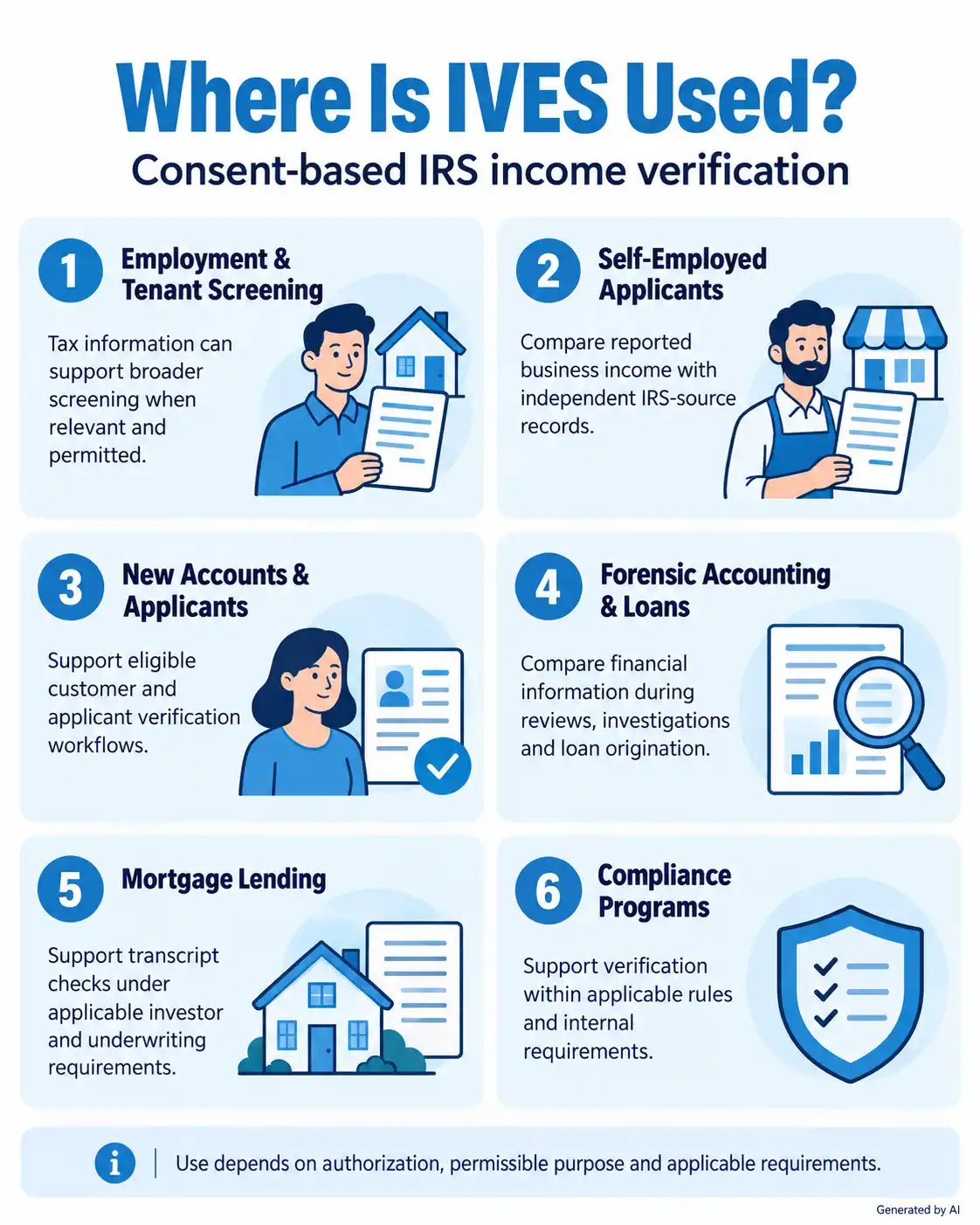
Where Employment and Income Verification via IVES Is Used
IVES can support a range of consent-based verification workflows and can help confirm the income claimed by the applicant, where allowed.
1. Employment and tenant screening
Employers and screening teams may use IRS wage or transcript information as part of broader employment screening services when employment- or income-related tax data is relevant to the permissible screening purpose.
2. Sole proprietors and self-employed applicants
IVES can provide an independent IRS-source record when the applicant is also the primary source of information about their own business and income. This can help organizations compare reported income with tax and wage information obtained through the IRS.
3. New accounts and other applicant purposes
Depending on the permissible purpose and applicable requirements, IVES may be used when verifying information for customers, new accounts, policyholders, and other applicants.
4. Forensic accounting and loan originations
IRS tax transcripts can help compare reported income and financial information with IRS-source records during financial reviews, investigations, underwriting, and loan-origination processes.
5. Mortgage lending
IVES and Form 4506-C are relevant to mortgage verification workflows governed by applicable investor and underwriting requirements, including requirements established by Fannie Mae. They should not be described as “federally mandated nationwide.” The Fannie Mae Selling Guide, Tax Return and Transcript Documentation Requirements outlines when Form 4506-C and IRS transcript information are required under Fannie Mae’s documentation rules.
6. Compliance programs
IVES may also support compliance with internal, state, federal, and industry requirements when income or employment-related information needs to be verified. Organizations should consider authorization, permissible purpose, record handling, and other applicable requirements as part of the broader process. AIS’s background check compliance guidance provides additional context for screening programs.
Why Choose AIS for IVES Verification
AIS provides IVES through a partnership with an IRS-authorized Participating Company integrated directly with the IRS. This gives AIS clients access to an authorized IVES channel rather than relying on a reseller, aggregator, or applicant-submitted documents.
That direct-source access is the same advantage that runs throughout IVES verification: organizations can compare reported wage, income, and tax information against IRS-source records while maintaining the taxpayer-consent process required by IVES.
AIS can also help incorporate IVES into a broader screening or verification workflow. IRS transcripts provide valuable employment- and income-related information, but they do not replace other checks that answer different questions about an applicant’s background or qualifications.
Conclusion
IVES gives organizations a consent-based way to obtain tax and wage information through an IRS-authorized process instead of relying solely on applicant-submitted documents.
When employment or income verification matters, direct IRS-source records can provide a stronger point of comparison while preserving taxpayer consent and supporting a more reliable verification process.
To discuss how IVES can work within your screening or verification program, contact us.