
CBSV helps businesses confirm whether an applicant’s name, Social Security number, and date of birth match records maintained by the Social Security Administration.
That matters when employers, lenders, tenant screening teams, financial institutions, and compliance professionals need a more direct source than third-party SSN trace data. Unauthorized applicants, synthetic identity fraud, and stale data can all create risk when a business relies on secondhand information alone.
This guide explains what CBSV is, how the consent based social security number verification process works, how CBSV differs from eCBSV and SSN trace data, and where businesses commonly use it.
What Is CBSV, and Who Runs It?
CBSV stands for Consent Based Social Security Number Verification. For anyone searching for CBSV meaning or asking what CBSV is, the simplest answer is this: CBSV is an SSA-run service that checks whether a submitted name, Social Security number, and date of birth match records held by the Social Security Administration.
According to the SSA, Consent Based Social Security Number Verification (CBSV) Service, CBSV can verify whether the SSN holder’s name, date of birth, and SSN match SSA records with the SSN holder’s consent. SSA also notes that CBSV does not verify identity, citizenship, employment eligibility, or satisfy DHS I-9 requirements.
That distinction matters. CBSV is not a full background check, credit check, employment verification, or criminal search. It answers a narrower but important identity-data question: does the submitted name, SSN, and date of birth match SSA records?
Businesses that already understand the benefits of background checks may use CBSV as an identity-verification layer before broader screening. Teams also reviewing online conduct can treat the benefits and risks of social media background checks as a separate due diligence topic.
How CBSV Works: Form SSA-89 and the Verification Process
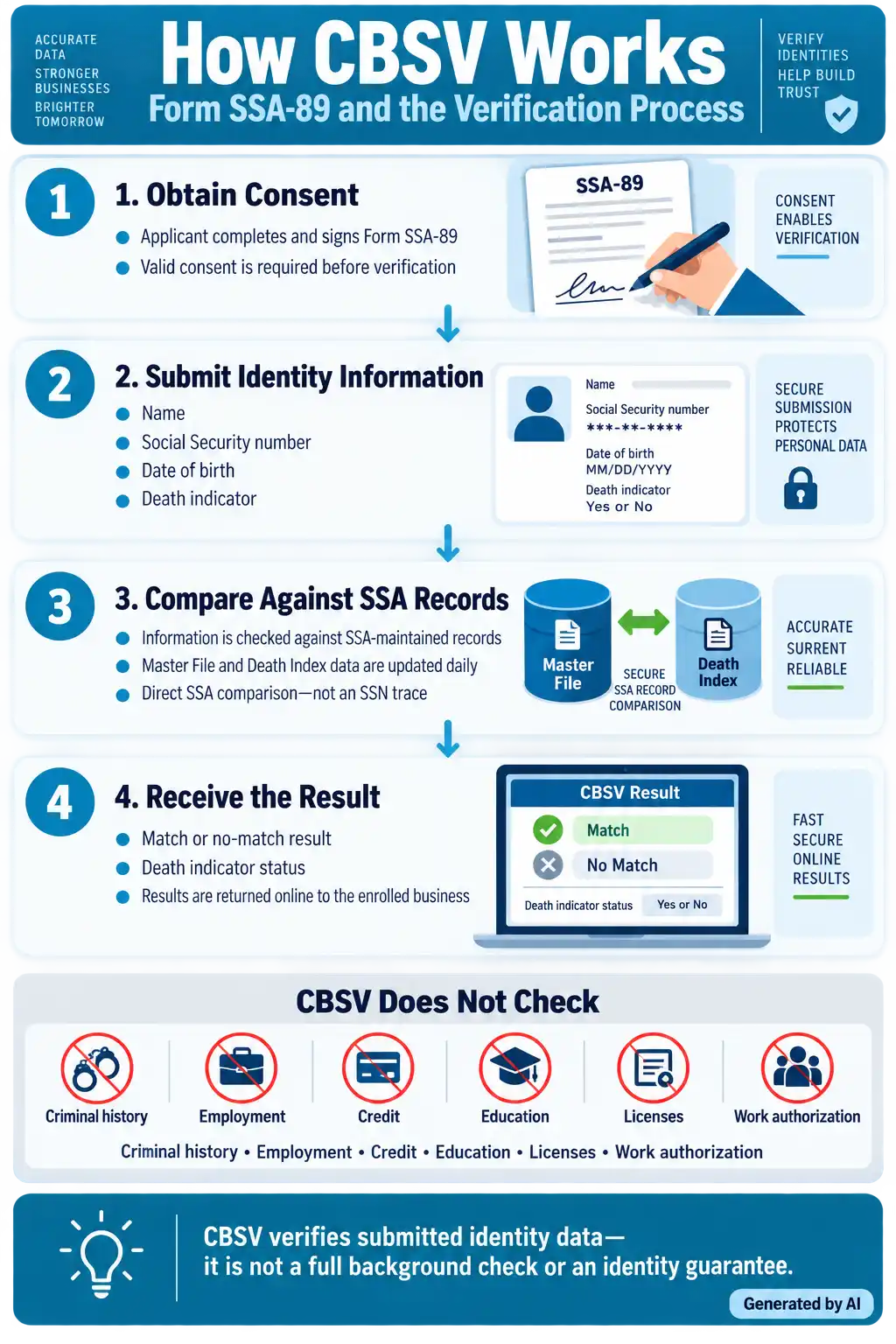
CBSV works by comparing consented applicant information against SSA-maintained records. The process centers on the CBSV form, Form SSA-89, which authorizes SSA to release SSN verification results.
The SSA Consent Based SSN Verification (CBSV) User Guide provides process detail for participating companies and helps define what CBSV verifies, how consent is handled, and how results are returned.
1. Getting Consent: Form SSA-89
Before a CBSV request can run, the applicant must authorize the verification through Form SSA-89. This wet-signed consent form is what makes CBSV consent based, rather than a lookup a business can run unilaterally.
Readers searching for CBSV SSA-89 – personal information are usually looking for this step: the applicant authorizes release of SSN verification results tied to their submitted personal information. Without valid consent, the verification should not proceed.
2. What Gets Checked: Name, SSN, Date of Birth, and Death Indicator
Once consent is on file, the CBSV comparison focuses on specific fields: name, Social Security number, date of birth, and death indicator. CBSV is limited to these identity-related fields.
It does not check criminal history, employment history, credit history, education, professional licenses, or work authorization. If an employer needs those searches, CBSV should be used alongside other screening services, not instead of them.
3. Where the Match Happens: SSA’s Master File and Death Index
CBSV checks the submitted name, Social Security number, date of birth, and death indicator against SSA-maintained Master File and Death Index records, which are updated daily.
Because CBSV compares information against SSA’s own records rather than a third-party copy of SSN-related data, it should be distinguished from SSN trace or credit-header data that may be stale, incomplete, or inconsistent.
This direct SSA record comparison is the core value of CBSV. It does not make CBSV a full background check or an absolute identity guarantee, but it gives businesses a stronger source for confirming whether submitted identity data matches SSA records.
4. How Results Come Back
CBSV results come back online after consent is in place and the request is submitted. The result tells the enrolled business whether the submitted information matches SSA records and whether SSA records indicate the SSN holder is deceased.
Because CBSV is part of a compliance-sensitive workflow, businesses should also consider broader background check compliance requirements when verification results may affect hiring, lending, tenant screening, or account decisions.
CBSV vs. eCBSV: What’s the Difference?
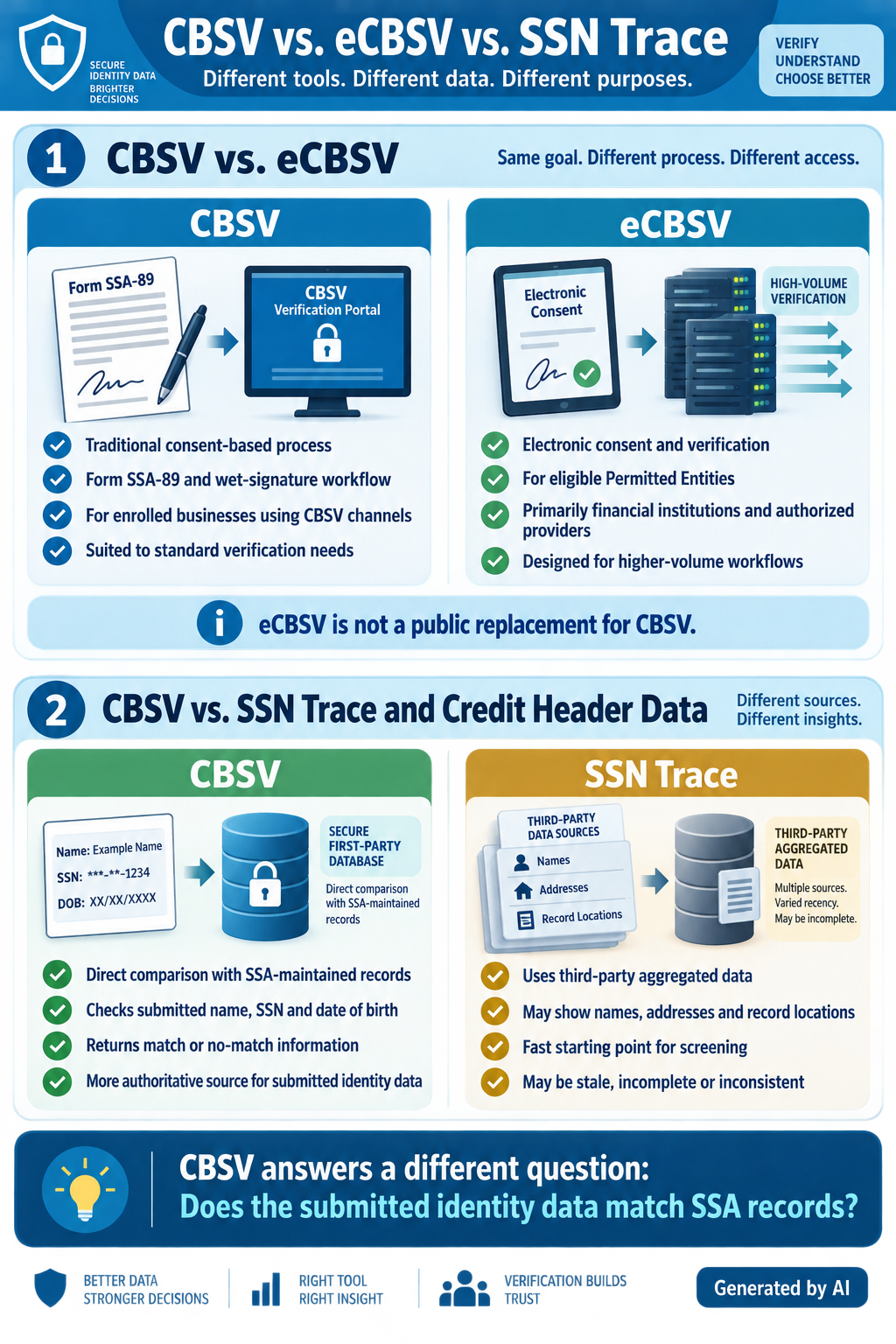
CBSV and eCBSV are both consent-based SSA verification services, but they serve different use cases. CBSV uses the traditional consent-based process, while eCBSV was designed for higher-volume electronic verification by eligible organizations.
According to SSA, eCBSV | Data Exchange, eCBSV is SSA’s electronic Consent Based Social Security Number Verification service. It allows eligible participants to submit verification requests electronically when they meet program requirements.
1. What eCBSV Is
eCBSV is the electronic counterpart to CBSV. It allows consent and verification to be handled electronically rather than through the older wet-signature workflow.
For financial institutions and other eligible participants, eCBSV can make the verification process easier to scale. It is not simply a public replacement for CBSV.
2. Who Qualifies: Permitted Entities
eCBSV is specifically for “Permitted Entities.” These are primarily financial institutions and their authorized service providers, as defined under the Economic Growth, Regulatory Relief, and Consumer Protection Act of 2018.
That means eCBSV is not open to every business in the same way a general CBSV service may be available through enrolled channels. Eligibility depends on whether the organization fits SSA’s permitted-entity requirements.
3. Why It Exists: Higher-Volume Electronic Verification
eCBSV exists because many financial institutions need to verify identity-related data at scale. Account openings, loan originations, and similar workflows may need electronic consent and electronic verification.
CBSV still matters for businesses that need consent-based SSA verification but do not qualify for, or do not require, the eCBSV model.
CBSV vs. SSN Trace and Credit Header Data
CBSV differs from SSN trace and credit header data because CBSV checks submitted information against SSA-maintained records. SSN trace and credit header data usually come from third-party aggregators, which means they can become stale or inconsistent between updates.
That does not mean every SSN trace is useless. Many businesses use SSN trace data as a fast starting point for screening. But social security verifications based on a direct SSA comparison answer a different and more authoritative question.
1. Why Businesses Default to SSN Trace Data
Businesses often default to SSN trace data because it is fast, familiar, and already built into many screening workflows. It can help identify names, address history, and possible record locations.
However, SSN trace data is not the same as CBSV. It does not confirm directly with SSA that the submitted name, SSN, and date of birth match SSA records.
2. The Problem With Third-Party Aggregated Data
Third-party SSN trace and credit header data is collected, updated, and resold through sources outside SSA. That means the information can lag behind official records or reflect outdated, incomplete, or manipulated data.
The issue is not that every third-party record is automatically wrong. The issue is that aggregated data is structurally different from a direct SSA match.
3. How CBSV Sidesteps That Problem
CBSV sidesteps that problem by checking against SSA’s own records. Instead of relying only on a secondhand data trail, CBSV confirms whether the submitted applicant data matches the records SSA maintains.
For businesses trying to reduce synthetic identity risk, unauthoriz
ed applicant risk, or data-quality uncertainty, that direct-source comparison is the core value of CBSV.
Where Businesses Use CBSV
Businesses use CBSV when they need a consent-based way to compare applicant identity data against SSA records. Common use cases include employment and tenant screening, new accounts, loan originations, fraud and security investigations, insurance, claims, and compliance programs.
1. Employment and Tenant Screening
Employers and tenant screening teams may use CBSV to help confirm that an applicant’s submitted SSN, name, and date of birth align with SSA records. This can support a cleaner screening process before other checks begin.
CBSV can work alongside broader employment screening services when organizations need identity verification as part of a larger hiring workflow.
2. New Accounts and Loan Originations
Financial institutions, lenders, and service providers may use CBSV or eCBSV in account-opening and loan-origination workflows. Use cases can include depository accounts, client or member onboarding, auto loans, personal loans, and mortgages.
These environments often carry identity-fraud exposure, especially when applicants submit identity data remotely or at scale.
3. Fraud, Security, and Compliance Programs
Fraud, security, special investigative, insurance adjustment, forensic accounting, and claims teams may use CBSV to reduce identity uncertainty in sensitive cases.
The SSA OIG, Social Security Administration’s Role in Combatting Identity Fraud (congressional testimony, May 25, 2023) highlights the ongoing importance of protecting SSNs and personally identifiable information from misuse.
CBSV may also support compliance programs tied to Customer Identification Programs, KYC, the FTC Red Flags Rule, Fannie Mae Loan Quality Initiative, and Dodd-Frank-related identity controls. Fraud risk is a material business concern: the ACFE, Occupational Fraud 2026: A Report to the Nations reports that organizations lose an estimated 5 percent of revenue to fraud each year.
AIS partners with an SSA-authorized enrolled company integrated directly with SSA to offer CBSV. If your organization needs help determining whether CBSV belongs in your screening program, or how it may work alongside employment screening services and social media screening service options, contact us