
Social media background screening is the process of reviewing a candidate’s publicly available social media activity to assess conduct, character, and potential hiring risks. When handled through a compliant third-party provider, it can add a useful layer to the employment screening process.
Done incorrectly, however, social media screening can expose employers to FCRA mistakes, EEOC concerns, privacy issues, and discrimination claims. This guide explains what social media background screening can reveal, how the process works, what legal requirements employers should understand, and how to screen candidates without creating unnecessary hiring risk.
What Is Social Media Background Screening?
Social media background screening is the process of reviewing publicly available online content connected to a job candidate or employee. A social media background check may include public posts, comments, images, videos, profile information, and public interactions on platforms such as Facebook, X/Twitter, Instagram, LinkedIn, TikTok, YouTube, and other searchable online communities.
For employers, social media screening for employment can add context that traditional background checks may not show, including public conduct, communication style, and behavior that could affect workplace safety, culture, or reputation. It can also help employers identify public red flags that may be relevant to a specific role, especially when the position involves trust, safety, customer interaction, or brand representation.
However, it should not be treated as an informal search through someone’s personal life. To be useful and compliant, social media background screening needs to be structured, consistent, limited to public content, and focused only on job-relevant findings.
1. What Can Social Media Screening Reveal?
A compliant social media background check should focus on defined, job-relevant categories rather than general personal information. Common categories of potentially reportable content include:
- Potentially Unlawful Activity: Public content that may suggest illegal conduct relevant to workplace risk.
- Potentially Violent Behavior: Public threats, promotion of violence, or extreme language that may raise safety concerns.
- Demonstrations of Intolerance: Racist, sexist, discriminatory, harassing, or hateful content that may conflict with workplace standards.
- Sexually Explicit Material: Explicit public content that may be relevant depending on the role, workplace, or employer policy.
Benefits of Social Media Background Screening
Social media screening can support a more complete hiring decision when it is used carefully and consistently.
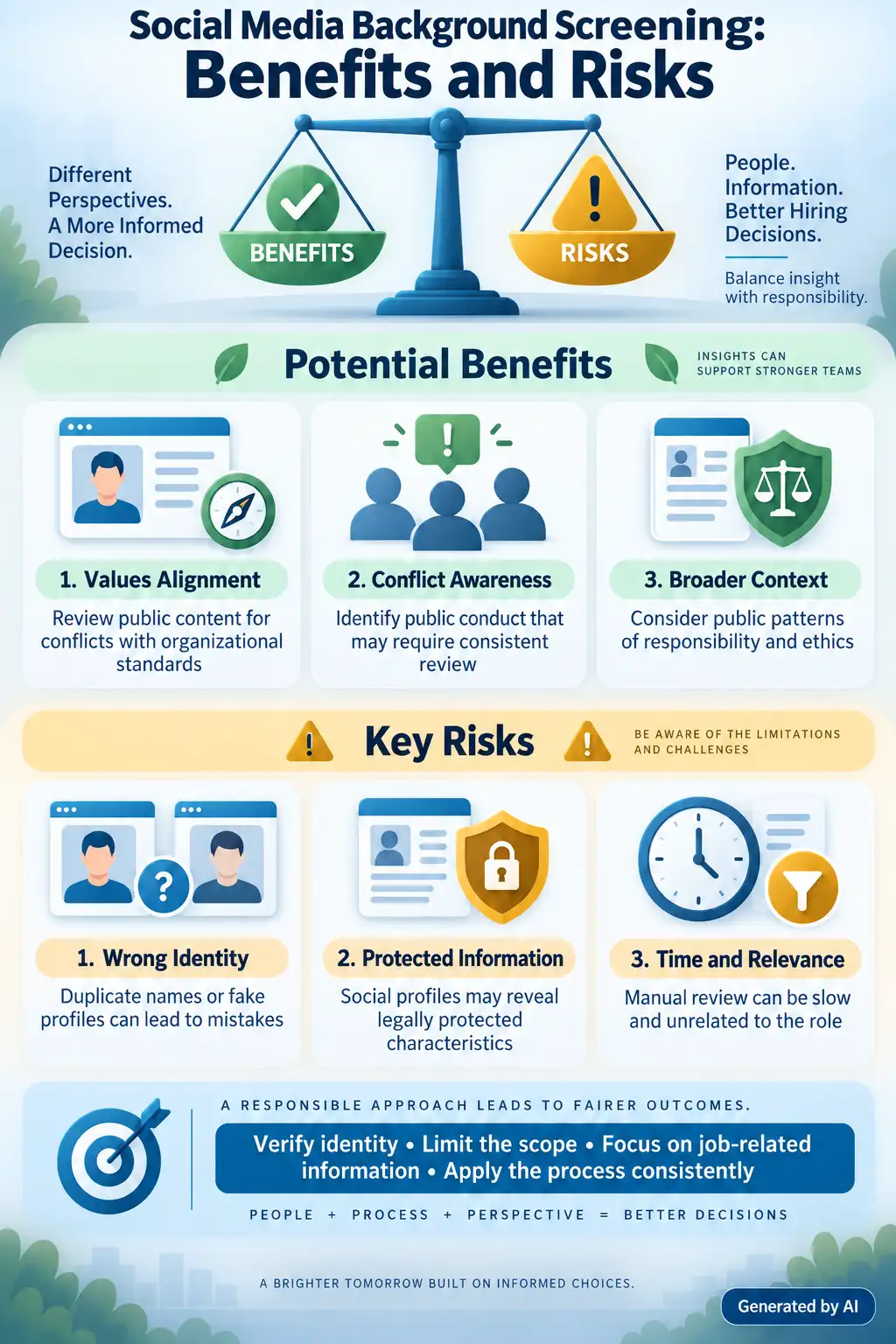
1. Ensuring the candidate matches the company’s culture and values.
Social media is a medium where many users feel comfortable sharing their values, goals, and personality with others. A review of these public comments and statements can help employers assess whether the recruit may conflict with the organization’s mission, whether on the clock or not.
2. Awareness of potential conflicts.
If an employee or recruit shows erratic or upsetting behaviors on social media, this could be a warning sign that their hire would bring the same kind of issues to the team. In a structured screening process, those concerns can be reviewed more consistently instead of relying on informal impressions.
3. Covering your assets.
Employees or candidates who show responsibility and ethics in their social media feed are more likely to carry those same attitudes and experiences into the workforce. Social media background screening can help employers identify public conduct patterns that support or raise concerns about a hiring decision.
Risks of Social Media Background Screening
The risks usually come from how the screening is performed, not from the idea of screening itself.
1. Not the right candidate.
Duplicate names, similar usernames, fake profiles, and limited public information can make it difficult to confirm that an account belongs to the person being screened. Without identity verification, an employer may connect the wrong content to the wrong candidate.
2. Beware of protected status discovery.
Social media can reveal information protected by federal, state, or local anti-discrimination laws, including age, religion, disability, pregnancy, race, or other protected characteristics. If that information affects the hiring decision, it can create compliance risk.
3. Timeliness issues.
Due to the large number of social media sites, attempting to review a candidate’s online activity manually can take a long time. Employers should decide in advance which roles require social media screening and why that screening is relevant to the position.
How Does Social Media Background Screening Work?
A compliant social media background screening process should be structured, repeatable, and limited to publicly available content. Employers should not rely on informal browsing, screenshots, or unverified assumptions. Working with AIS employment screening services can help keep the process more consistent and documented.
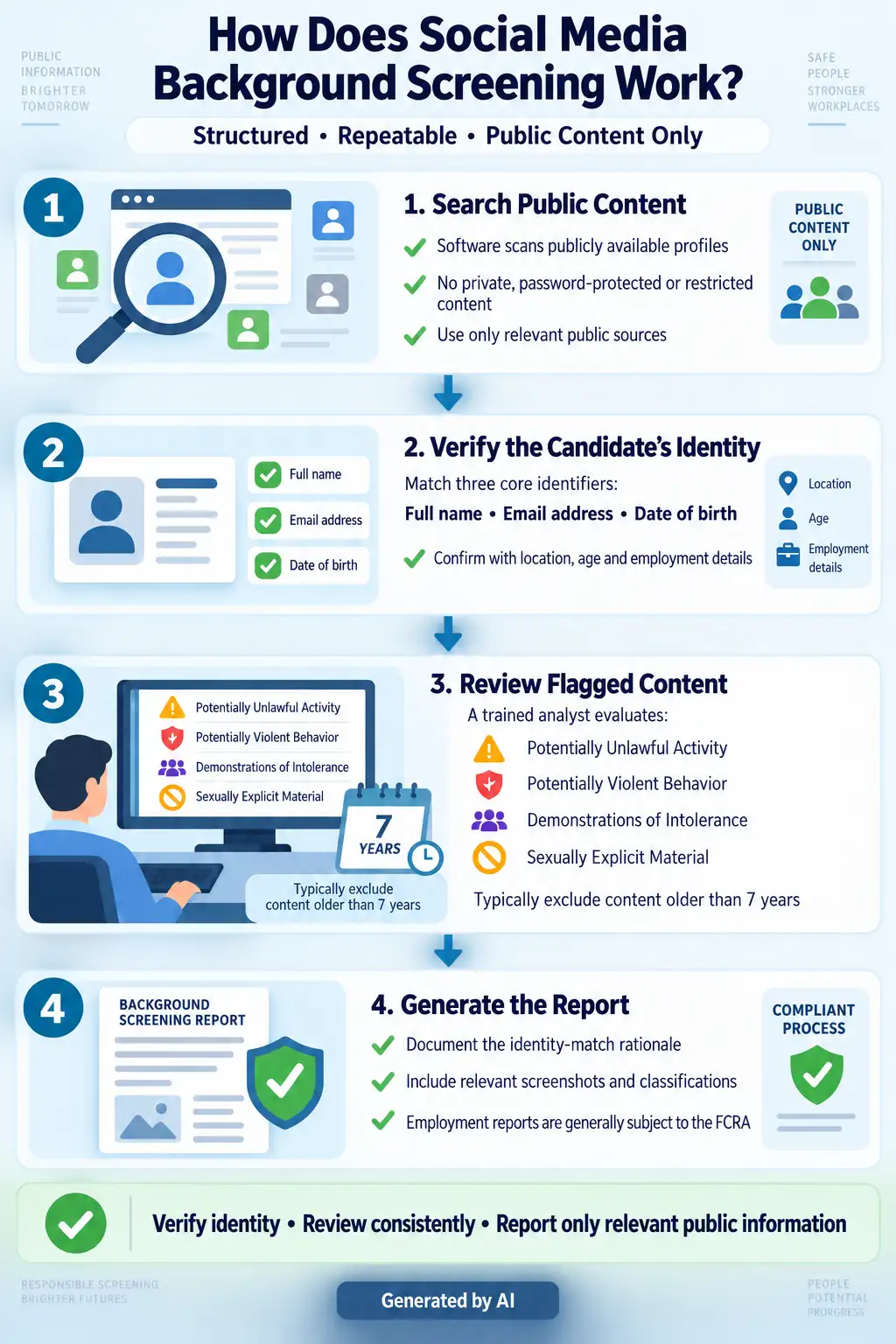
Step 1: The Search
The process begins when proprietary software scans publicly available social media accounts connected to the candidate. Private accounts, password-protected profiles, and restricted content are not accessible. Commonly searched platforms may include Facebook, X/Twitter, Instagram, LinkedIn, and TikTok, while quasi-private platforms like Reddit may be included only when content has been made public.
Step 2: Identity Verification
Identity verification confirms that the account belongs to the candidate being screened. This usually involves matching three core identifiers: full name, email address, and date of birth, along with contextual factors such as age, location, employment history, or profile details. Incorrect identity matching is one of the most common causes of false positives and legal exposure.
Step 3: Content Review
A trained Social Media Analyst reviews flagged content against the four defined categories: Potentially Unlawful Activity, Potentially Violent Behavior, Demonstrations of Intolerance, and Sexually Explicit Material. Only recent, relevant content should be considered, and content older than seven years is typically excluded. This 7-year lookback rule helps employers avoid relying on stale information that may no longer reflect current workplace risk.
Step 4: Reporting
A formal report is generated with the identity match rationale, screenshots of flagged content, and the content category classification. When prepared by a third-party provider for employment purposes, this report is generally treated as a consumer report under the FCRA.
Legal Requirements for Social Media Background Screening
Social media background screening can be legal when it is consistent, job-related, and aligned with federal, state, and local requirements. The main risks in social media background check laws come from how information is collected, reviewed, and used.
1. FCRA Requirements
When a third-party provider conducts FCRA social media screening, the report is generally treated as a consumer report. The FTC explains that employers using background reports for employment purposes must provide proper disclosure, obtain written authorization, and follow adverse action procedures when findings may affect a hiring decision. Before adverse action, send a pre-adverse action notice with a copy of the report and “A Summary of Your Rights Under the Fair Credit Reporting Act.” If the decision moves forward, send a final adverse action notice. For more detail, review AIS’s guide to background check compliance requirements.
2. EEOC and Protected Characteristics
Social media can reveal information protected by the Equal Employment Opportunity Commission. The EEOC states that employers must avoid using background information in a way that discriminates based on protected characteristics, including race, color, national origin, sex, religion, disability, age, or genetic information.
The following information should not be used to deny employment:
- Age
- Citizenship
- Pregnancy or children
- Sexual orientation
- Disabilities
- Gender
- Religion
- Race
Even if the employer did not intend to use protected information, seeing it can create legal exposure. A third-party screening process helps reduce that risk by filtering protected characteristics before the report reaches the hiring manager.
2. State Social Media Password Protection Laws
Several states prohibit employers from requesting candidates’ private social media passwords or requiring account access. The National Conference of State Legislatures tracks state laws restricting employer access to applicants’ and employees’ social media usernames, passwords, and personal account content.
AIS social media background screening only covers publicly available content; private accounts and password-protected content should not be accessed.
3. The Catch-22
While information that is posted publicly isn’t always protected by privacy laws, the HOW and WHY a potential or current employer uses this data and information is protected by the same discrimination and fair hiring laws and policies as other background checks that review and look for criminal backgrounds, education verification, and the like.
That is why a structured third-party process matters.
Social Media Screening Laws by State: What Employers Need to Know
Social media background check laws by state vary, especially when it comes to private account access. In many states, the key question is not simply “can employers check social media before hiring?” but whether employers can request passwords, demand access to private accounts, or require candidates to expose restricted content.
This table is for general informational purposes only. Laws may have been updated, and employers should verify current state and local requirements and consult legal counsel before relying on any state-specific rule.
State | Law / Restriction | What It Covers |
California | Labor Code § 980 | Prohibits requesting passwords, requiring access in the employer’s presence, or demanding access to personal social media accounts |
New York | Labor Law § 201-i | Prohibits requesting access to employee or applicant personal accounts, with limited exceptions for business or nonpersonal accounts |
Illinois | Right to Privacy in the Workplace Act | Prohibits requesting passwords or demanding access to personal online accounts |
Maryland | Labor & Employment § 3-712 | Prohibits requesting or requiring usernames, passwords, or other access credentials for personal accounts |
Michigan | Internet Privacy Protection Act | Restricts employers and educational institutions from requiring access to personal internet accounts |
Washington | RCW 49.44.200 | Prohibits requesting login information, requiring account access, forcing contact additions, or requiring privacy-setting changes |
Colorado | C.R.S. § 8-2-127 | Prohibits employers from requesting or requiring access to personal social media accounts or related login information |
Oregon | ORS 659A.330 | Restricts forced access to password-protected personal social media accounts |
Nevada | NRS § 613.135 | Prohibits employers from requiring access information for personal social media accounts |
New Jersey | P.L.2013, c.155 / N.J.S.A. 34:6B-5 et seq. | Restricts employers from requiring access to private personal social media accounts |
These laws generally reinforce the same practical rule: employers should not request private social media access. Screening only publicly available content, as AIS and qualified third-party providers do, helps employers avoid many of the privacy risks these laws are designed to address.
Social Media Background Screening Best Practices for Employers
Use this social media screening best practices checklist to keep social media pre employment screening and social media screening for employment consistent, compliant, and defensible:
- Use a qualified third-party provider. A provider can support FCRA compliance, identity matching accuracy, and protected-characteristic filtering.
- Create a written social media screening policy. Define when screening is used, which roles it applies to, and what findings may be considered.
- Obtain written consent before screening. Candidates should know when social media background screening may be part of the hiring process.
- Screen only publicly available content. Do not request passwords, private account access, or permission to bypass privacy settings.
- Document findings that influence a hiring decision. Keep a clear record of what was found and why it mattered.
- Apply screening consistently across candidate pools. Inconsistent use can create disparate impact or disparate treatment exposure.
- Follow the full FCRA adverse action process before rejecting a candidate. Give candidates required notices and a chance to respond.
- Review and update your policy annually. State laws and platform practices change, so policies should keep pace.
Employers can also work with employment screening services for employers to support a more consistent screening workflow.
Which Social Media Platforms Are Included in a Background Screen?
A social media background check may include several public-facing platforms, depending on the provider, the role, and the employer’s screening policy. For HR teams asking what does social media background screening include, the key point is that compliant social media background screening is limited to publicly accessible content, not private or password-protected accounts.
Platform | Publicly Searchable | Typically Included | What It May Reveal |
Yes, public posts/profiles | Yes | Personal views, behavior, activity, associations | |
X / Twitter | Yes, public accounts | Yes | Opinions, language, conduct, public disputes |
Yes, public accounts only | Yes | Lifestyle, behavior, visual content | |
Yes | Yes | Professional history, endorsements, activity | |
TikTok | Yes, public accounts | Yes | Behavior, language, video content |
YouTube | Yes, public channels | Yes | Published video content and comments |
Quasi-private / community-gated | When public-facing | Searchable content when shared publicly or cross-posted | |
Discord | Private by default | Rarely | Only if content has been made public elsewhere |
Snapchat | Private by default | No | Ephemeral content, not typically accessible |
The specific platforms reviewed may vary by provider. AIS and qualified third-party providers only review publicly available content; private accounts, restricted profiles, password-protected pages, and private messages should not be accessed.
Why You Shouldn’t Screen Candidates’ Social Media Yourself
Many HR managers ask, “can employers check social media before hiring?” The issue is not whether public content exists, but whether social media screening for employment is handled in a consistent, documented, and legally defensible way.
Informal self-searches can create several problems:
- Protected characteristic exposure. Employers may immediately see information they should not factor into a hiring decision, including age, religion, pregnancy, race, disability, or political views. Once seen, it can be difficult to prove that information did not influence the decision, creating disparate treatment exposure.
- No identity verification. A self-search has no formal process for confirming that an account actually belongs to the candidate. Employers can easily connect the wrong profile to the wrong person, especially with common names or similar usernames.
- No FCRA social media screening workflow. A self-conducted social media review is not a consumer report under the FCRA, so it does not trigger the same disclosure, consent, or adverse action workflow. However, using that information in a hiring decision can still create EEOC exposure.
- No clear documentation. A third-party report can document what was found, how identity was verified, and what content category applied. A self-search often leaves no consistent audit trail if the decision is later challenged.
There is a right way and a wrong way to use social media in hiring. AIS social media background screening services help employers like you keep the process structured, consistent, and focused on job-relevant findings.
How AIS Supports Compliant Social Media Background Screening
For employers, the challenge with social media background screening is not simply finding public information. It is knowing whether the information belongs to the right person, whether it is legally safe to review, and whether it can be documented in a defensible way.
AIS helps employers using social media screening for employment manage those risks through identity matching accuracy, protected characteristic filtering, and FCRA-compliant reporting when a third-party report is used for employment purposes. That gives HR teams a more structured way to review public online information without relying on informal self-searches.